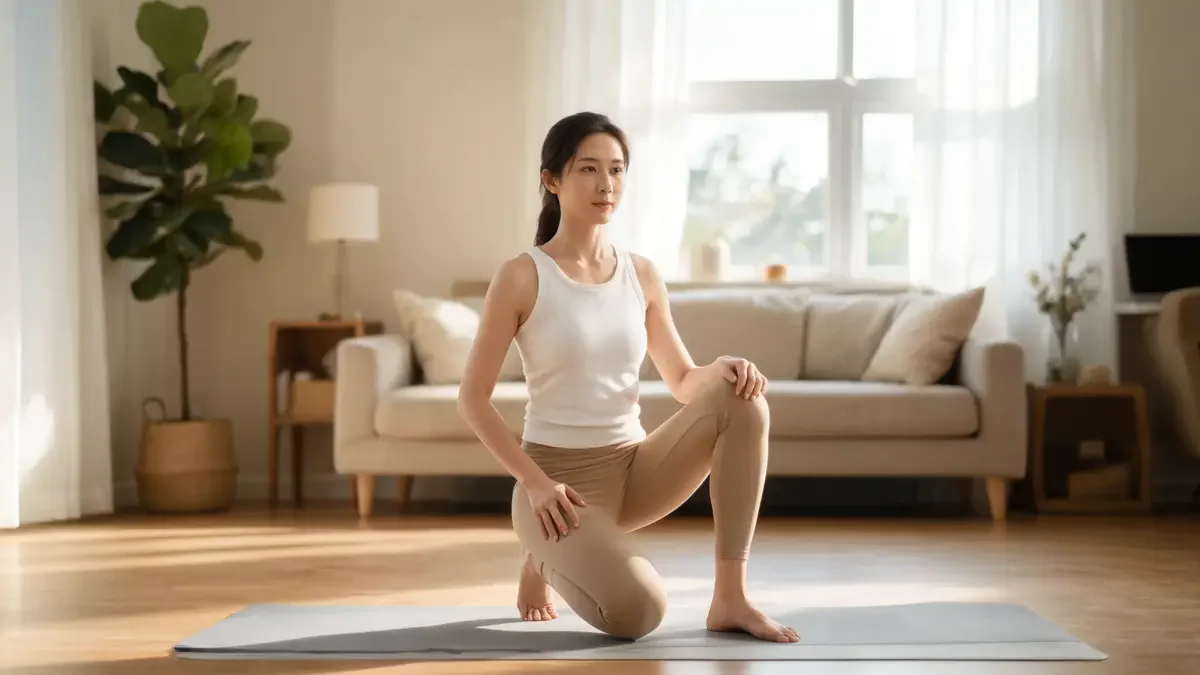
The mechanism: articular cartilage is avascular (no blood supply) and gets its nutrients from the synovial fluid around it. The movement of the joint pumps this fluid in and out, delivering nutrients to cartilage and removing waste products. Extended immobility starves cartilage. Appropriate movement feeds it. This is why physical therapists universally recommend movement for arthritis, even when movement hurts.
The critical modifier is appropriate movement. High-impact, torsional, or uncontrolled movement accelerates cartilage wear. Low-impact, controlled, joint-aligned movement nourishes cartilage and strengthens the muscles that protect the joint from excess load.
Quad Sets (Seated or Lying)
Tighten the quadriceps while sitting or lying with a straight leg. No joint movement, no impact, no risk. Strengthens the VMO (vastus medialis oblique), the quad muscle most directly associated with knee joint stability. Perform 10-15 reps, 3x daily. Start here before progressing to any other exercise.
Use red light therapy before or after exerciseStraight Leg Raises
Lying on your back, tighten the quad and raise the straight leg to 45 degrees. Hold 3 seconds, lower slowly. Builds quad strength without knee joint compression. 3 sets of 10.
Support with Performance Lab FlexMini-Squats (Wall-Supported, 0-30 Degrees)
Standing with back to wall, slide down until the knee bends to approximately 30 degrees. Hold 5 seconds, slide back up. This limited range avoids the peak compression forces that occur at deeper squat angles while still loading the quad and VMO. 3 sets of 10.
Consider a knee sleeve for supportWater Walking
Walking in chest-deep water reduces the ground reaction force at the knee by approximately 75%. For people whose land walking is too painful to maintain adequacy, water walking provides the articular cartilage pumping benefit of ambulation without the compression. Most public pools have open swim times suitable for this.
Right shoes matter outside the pool tooCycling (Stationary, Low Resistance)
Stationary cycling at low resistance maintains knee range of motion, strengthens quad and hamstring, and provides cardiovascular benefit with minimal peak joint stress. Seat height is critical: the knee should be nearly fully extended at the bottom of the pedal stroke to avoid high-compression positions.
Red light therapy supports post-exercise recoveryHamstring Curls (Lying, with Band)
Arthritis strengthening programs often over-focus on the quad, creating muscle imbalance that actually increases medial knee stress. Lying hamstring curls with a light resistance band restore the posterior chain balance and reduce patellofemoral compression.
Joint supplement supportSeated Calf Raises
Arthritic knees often develop limited range of motion over time. Seated calf raises pump the calf muscle, improving venous return and reducing the synovial fluid stagnation that worsens morning stiffness. Perform 3 sets of 15 daily, including first thing in the morning before standing.
Pair with infrared heat for morning stiffnessSupport your exercise with red light recovery
Red light therapy post-exercise reduces the inflammation triggered by activity without eliminating the beneficial training adaptation. Many arthritis patients use NovaaLab for 15 minutes after their daily walking or exercise routine.
Check NovaaLab for Post-Exercise Recovery